I probably need to start covering movies I'm not absolutely drooling for in this yes, no, maybe so trailer series. It gets hard to pick the "no" and "maybe" elements for a film like, say, this one here...
John Cameron Mitchell's RABBIT HOLE will hit theaters, albeit only a few of them we're guessing, on December 17th, a date obviously chosen with the perception that it will maximize Oscar prospects.
YES I am, for better or worse, what is known as a "fan" which is to say, once I love something, it tends to be intense (hair pulling excitement, joyful weeping... metaphorically speaking!) and it takes a lot for that love to die out . The word "fan" used to have both negative and positive connotations but now, I suppose, with the invention of the terms "fanboy" and "fangirl", the simpler word "fan" has lost some of its negative connotations. So I'm okay. I'm still discerning. Unless you think I'm a closer to a Kidman "fanboy" in which case, well, yeah, maybe but shut up -- [hyperventilating, crying] She is awesome!
NO Grief as Major Theme is tricky to pull off. There are all sorts of movie potholes on that journey: pornographic actorly histrionics, pandering "everything happens for a reason!" sentimentality, monotony of tone, boredom of plot. Plus the best work in this genre is nearly impossible to live up to. The best grief dramas are always French (Ponette and Trois Coleurs: Bleu) or are one hour long and found in really unexpected places ("The Body"). But it could be I am just overly touchy on this subject because it cuts too close to the bone when it's sharp. When it's dull, it just makes an awful mess of an important and universal topic. I hope this one is sharp, even though that means it'll hurt more.
MAYBE SO Ever since I heard about the artistic teenager that becomes intermingled with the grieving family, I was curious about how John Cameron Mitchell, who proved a very visual director in his first two features (Shortbus and Hedwig and the Angry Inch), would work that in. I'm pleased to note that the marketing team has used it as a sort of guiding motif in the trailer. I love the linear drawing emphasizing the Academy Award titling, don't you? It somehow seems more playful -- and the Oscars should be cuz they're fun! -- than the boring title cards we usually get when studios want you to know that "A PRESTIGE MOVIE IS COMING!"
Even if this movie didn't have such great festival buzz and Best Actress hype, I would still be a YES as all three principle actors are people I either obsessively love (Kidman) have loved ever since I can remember and always will (Wiest) or generally quite like (Eckhart).
But maybe your reaction veers far off in some other direction? Are you a yes, no or a maybe so when it comes to Rabbit Hole and why?
*
Showing posts with label Dianne Wiest. Show all posts
Saturday, October 23, 2010
Wednesday, September 22, 2010
Familiar Faces: The Woody Allen Hierarchy.
Woody Allen's newest feature You Will Meet A Tall Dark Stranger opens today in movie theaters. It's currently confusing me with its Curse of The Jade Scorpion or The Purple Rose of Cairo -like silhouette poster. With this move the marketing department has made me recall both the worst and the best from Woody Allen's filmography simultaneously. It's very schizo... maybe this means the new feature will be right smack dab in the middle, neither essential nor embarrassing?
Why couldn't they have gone with the European poster treatment? European posters are always better. It's a law of Hollywood's nature.
To celebrate its release -- I haven't had time to see it yet -- I wanted to revamp an old list I started years ago. When Vicky Cristina Barcelona was cast in 2007, numerous media outlets were making ridiculously inaccurate claims about Scarlett Johansson being Woody's third most consistent muse (talk about A list tunnel vision!). Those inaccuracies of reporting died down as soon as Scarlett missed a movie. But this list I found interesting in the creation nonetheless and I hope you will in the reading. I've attempted a comprehensive list of collaborations but there are bound to be a few mistakes -- particularly in the area of tiny character actor roles so do note any omissions should you spot them in the comments.
For this ranking, I'm counting only the feature films he directed (plus his third of New York Stories and his one telefilm Don't Drink the Water). The actors, male and female, who've logged the most time with the prolific writer/director are...
01 26 Times. Woody Allen himself. Well you do have to direct yourself if you're also acting. It's 27 if you count a film he didn't direct but wrote & starred in: Play it Again, Sam.
02 13 Times. Mia Farrow is the queen. Remarkably and horrifically, despite the plentiful acting nominations earned by Woody Allen films, she's still never been nominated for an Oscar.
Keaton in Sleeper, Love and Death, Annie Hall, Interiors, Manhattan,
Radio Days and Manhattan Murder Mystery
03 7 and 7.5 Times. Diane Keaton is the runner up woman. Her most famous appearance was for her Oscar win as Annie Hall but she returned to the fold rather blissfully as his wife in Manhattan Murder Mystery and proved that the two of them hadn't lost an ounce of their chemistry. One wonders why they haven't tried an eighth time... (or ninth time if you could Play it Again, Sam which Woody did not direct so we gave her a half point there). Fred Melamed, who so recently nailed his supporting role in the Coen Bros' A Serious Man as huggy Sy Ableman, probably looked familiar to you. That's because he's all over the place in the Woody filmography albeit in small roles. And finally, there's Julie Kavner. Her most memorable part was as Woody's co-worker in Hannah and Her Sisters. Yes that's "Marge Simpson" we're talking about.
04 6 Times. Maurice Sonnenberg and Peter Catellotti have roles like "Movie Theater Patron" in Anything Else or "Sound Recordist" in Celebrity. But since they're in six movies each, one assumes they're either spectacular extras or friends with Woody or the casting director.
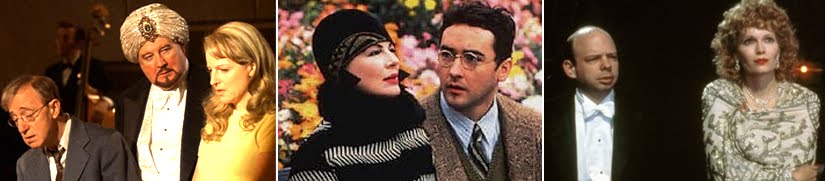
05 5 Times. Dianne Wiest Wiest won both of her very deserved Oscars for Allen pictures (Hannah and Her Sisters & Bullets Over Broadway). If you've ever wondered why actors are so obviously desperate to work with him, consider this: He's guided thespians to 15 nominations with 6 wins among them - one of the best records of all time.) The instantly recognizable Wallace Shawn has also been in a whole handful of Woody film albeit in smaller roles. You may remember him as The Masked Avenger in Radio Days. David Ogden Stiers (of TV's MASH fame) was another regular.
06 4.5 Times. Louise Lasser has appeared in 4 films but she also does voice work in his first film What's Up Tiger Lily (1966) so let's allow for that with this special designation. Same goes for Tony Roberts, who appeared most famously in Annie Hall. His count would be 5 if you allowed for Play it Again, Sam but Woody only wrote that film and didn't direct it, so we'll give him a half credit there.
[clockwise from top left: Lasser in Bananas; Roberts in Annie Hall;
Waterston in September; Judy Davis in Husbands and Wives
07 4 Films. Judy Davis nearly won an Oscar for Husbands and Wives. Sam Waterston also appears in four films. His most significant role is, if I'm remembering correctly, in September but this was notoriously not a happy film, having been reshot and delayed and not causing much of a stir when it opened despite Woody's semi-popularity at the time.
08 3 Films. Scarlett Johansson has the leading role in three of his films, winning the most mileage from their first outing, Match Point. Alan Alda has also worked three characters in the Woody gallery, most notably in Crimes and Misdemeanors. The following actors have also been in three Woodys: Danny Aiello, Philip Bosco (a familiar TV face last seen on Damages), Frances Conroy (all of her roles predate the Six Feet Under career peak), Blythe Danner (Gwynnie's mom!) Julie Halston, Annie Joe Edwards and Camille Saviola and Jack Warden.
Theron in Celebrity; Daniels in Purple Rose; Hemingway in Manhattan; Huston
in Manhattan Murder Mystery; Balaban in Deconstructing Harry; Ullman in
Small Time Crooks; Clarkson in Whatever Works
09 2 Films. I'm sure to forget someone here but well over a dozen actors have done double duty including: Bob Balaban, Ewen Bremner (yes, that's "Spud" from Trainspotting), Josh Brolin, Patricia Clarkson, Lynn Cohen, Jeff Daniels (who deserved an Oscar nomination for The Purple Rose of Cairo), Larry David, Julia Louis-Dreyfus, Gregg Edelman, director Nora Ephron (only cameos), Stephanie Farrow, Rupert Frazer, Joanna Gleason, Jessica Harper, Mariel Hemingway (Oscar nominated for Manhattan), Anjelica Huston, Erica Leerhsen, Debra Messing, Gretchen Mol, Zak Orth, Michael Rapaport, Deborah Rush, Marian Seldes, Tina Sloan, Charlize Theron, Michael Tucker, Loretta Tupper and Tracey Ullman.
10 1.5 Films. Christopher Evan Welch, pictured left, Vicky Cristina Barcelona's omniscient narrator, actually appears physically in Whatever Works. (He can currently be seen as "Grant Test" on AMC's new series Rubicon.) Great speaking voice, eh?
∞ 1 Film. Everyone with a SAG card... or thereabouts. Though when you look at people who made very strong impressions in their sole appearance, you do wonder why there wasn't another film. I'm thinking of Martin Landau (Crimes and Misdemeanors - Oscar nom), Elaine May (Small Time Crooks -NSFC Best Supporting Actress) and Goldie Hawn (Everyone Says I Love You) in particular, who all seemed like natural fits in the Woody-verse. Most of the members of the You Will Meet a Tall Dark Stranger ensemble are newbies save for Brolin and Bremner making their second films. Midnight in Paris, which recently completed shooting, is entirely Allen virgins but for Kathy Bates who was last seen as a prostitute in his experimental black and white picture Shadows and Fog (1991).
Who do you wish he would work with again?
*
Why couldn't they have gone with the European poster treatment? European posters are always better. It's a law of Hollywood's nature.
To celebrate its release -- I haven't had time to see it yet -- I wanted to revamp an old list I started years ago. When Vicky Cristina Barcelona was cast in 2007, numerous media outlets were making ridiculously inaccurate claims about Scarlett Johansson being Woody's third most consistent muse (talk about A list tunnel vision!). Those inaccuracies of reporting died down as soon as Scarlett missed a movie. But this list I found interesting in the creation nonetheless and I hope you will in the reading. I've attempted a comprehensive list of collaborations but there are bound to be a few mistakes -- particularly in the area of tiny character actor roles so do note any omissions should you spot them in the comments.For this ranking, I'm counting only the feature films he directed (plus his third of New York Stories and his one telefilm Don't Drink the Water). The actors, male and female, who've logged the most time with the prolific writer/director are...
Woody Players ... Quantitatively Speaking
01 26 Times. Woody Allen himself. Well you do have to direct yourself if you're also acting. It's 27 if you count a film he didn't direct but wrote & starred in: Play it Again, Sam.
02 13 Times. Mia Farrow is the queen. Remarkably and horrifically, despite the plentiful acting nominations earned by Woody Allen films, she's still never been nominated for an Oscar.
Keaton in Sleeper, Love and Death, Annie Hall, Interiors, Manhattan, Radio Days and Manhattan Murder Mystery
03 7 and 7.5 Times. Diane Keaton is the runner up woman. Her most famous appearance was for her Oscar win as Annie Hall but she returned to the fold rather blissfully as his wife in Manhattan Murder Mystery and proved that the two of them hadn't lost an ounce of their chemistry. One wonders why they haven't tried an eighth time... (or ninth time if you could Play it Again, Sam which Woody did not direct so we gave her a half point there). Fred Melamed, who so recently nailed his supporting role in the Coen Bros' A Serious Man as huggy Sy Ableman, probably looked familiar to you. That's because he's all over the place in the Woody filmography albeit in small roles. And finally, there's Julie Kavner. Her most memorable part was as Woody's co-worker in Hannah and Her Sisters. Yes that's "Marge Simpson" we're talking about.
04 6 Times. Maurice Sonnenberg and Peter Catellotti have roles like "Movie Theater Patron" in Anything Else or "Sound Recordist" in Celebrity. But since they're in six movies each, one assumes they're either spectacular extras or friends with Woody or the casting director.
05 5 Times. Dianne Wiest Wiest won both of her very deserved Oscars for Allen pictures (Hannah and Her Sisters & Bullets Over Broadway). If you've ever wondered why actors are so obviously desperate to work with him, consider this: He's guided thespians to 15 nominations with 6 wins among them - one of the best records of all time.) The instantly recognizable Wallace Shawn has also been in a whole handful of Woody film albeit in smaller roles. You may remember him as The Masked Avenger in Radio Days. David Ogden Stiers (of TV's MASH fame) was another regular.
06 4.5 Times. Louise Lasser has appeared in 4 films but she also does voice work in his first film What's Up Tiger Lily (1966) so let's allow for that with this special designation. Same goes for Tony Roberts, who appeared most famously in Annie Hall. His count would be 5 if you allowed for Play it Again, Sam but Woody only wrote that film and didn't direct it, so we'll give him a half credit there.
[clockwise from top left: Lasser in Bananas; Roberts in Annie Hall;Waterston in September; Judy Davis in Husbands and Wives
07 4 Films. Judy Davis nearly won an Oscar for Husbands and Wives. Sam Waterston also appears in four films. His most significant role is, if I'm remembering correctly, in September but this was notoriously not a happy film, having been reshot and delayed and not causing much of a stir when it opened despite Woody's semi-popularity at the time.
08 3 Films. Scarlett Johansson has the leading role in three of his films, winning the most mileage from their first outing, Match Point. Alan Alda has also worked three characters in the Woody gallery, most notably in Crimes and Misdemeanors. The following actors have also been in three Woodys: Danny Aiello, Philip Bosco (a familiar TV face last seen on Damages), Frances Conroy (all of her roles predate the Six Feet Under career peak), Blythe Danner (Gwynnie's mom!) Julie Halston, Annie Joe Edwards and Camille Saviola and Jack Warden.
Theron in Celebrity; Daniels in Purple Rose; Hemingway in Manhattan; Hustonin Manhattan Murder Mystery; Balaban in Deconstructing Harry; Ullman in
Small Time Crooks; Clarkson in Whatever Works
09 2 Films. I'm sure to forget someone here but well over a dozen actors have done double duty including: Bob Balaban, Ewen Bremner (yes, that's "Spud" from Trainspotting), Josh Brolin, Patricia Clarkson, Lynn Cohen, Jeff Daniels (who deserved an Oscar nomination for The Purple Rose of Cairo), Larry David, Julia Louis-Dreyfus, Gregg Edelman, director Nora Ephron (only cameos), Stephanie Farrow, Rupert Frazer, Joanna Gleason, Jessica Harper, Mariel Hemingway (Oscar nominated for Manhattan), Anjelica Huston, Erica Leerhsen, Debra Messing, Gretchen Mol, Zak Orth, Michael Rapaport, Deborah Rush, Marian Seldes, Tina Sloan, Charlize Theron, Michael Tucker, Loretta Tupper and Tracey Ullman.
10 1.5 Films. Christopher Evan Welch, pictured left, Vicky Cristina Barcelona's omniscient narrator, actually appears physically in Whatever Works. (He can currently be seen as "Grant Test" on AMC's new series Rubicon.) Great speaking voice, eh?∞ 1 Film. Everyone with a SAG card... or thereabouts. Though when you look at people who made very strong impressions in their sole appearance, you do wonder why there wasn't another film. I'm thinking of Martin Landau (Crimes and Misdemeanors - Oscar nom), Elaine May (Small Time Crooks -NSFC Best Supporting Actress) and Goldie Hawn (Everyone Says I Love You) in particular, who all seemed like natural fits in the Woody-verse. Most of the members of the You Will Meet a Tall Dark Stranger ensemble are newbies save for Brolin and Bremner making their second films. Midnight in Paris, which recently completed shooting, is entirely Allen virgins but for Kathy Bates who was last seen as a prostitute in his experimental black and white picture Shadows and Fog (1991).
Who do you wish he would work with again?
*
Tuesday, September 14, 2010
TIFF: A Glimpse of Rabbit Hole Enthusiasm To Come?
Nicole Kidman and hubby hit Toronto for the film festival. I haven't seen more than one true review yet, but she wore Prada. Just Jared has pics from the premiere.As for the review(s)? Well it's mostly tweets at this point though I expect more reviews to emerge soon. Let's start negative and get positive.
Negative
- @ioncinema "Belly flop for JCM. Wish entry point into story was at the 10month point. Wish final scene was extended by 90 mins."
- @matt_mazur "Rabbit Hole was really mediocre. Kidman was great but the rest uninspired. Let down"
- The Playlist "honest and powerful"
- Deadline NY "Nicole Kidman making a major artistic comeback"
- @PeterKnegt of IndieWire says 'Bad buzz be damned. Quietly haunting and very affecting. Very strong and naturalistic work from Nicole Kidman'
- @Scott_Tobias "B+) Movie about loss of a child, on no sleep and a week away from my own kid? No way this wasn't going to wreck me."
- @juanmgc "Powerful. Remarkable. Kudos to John Cameron Mitchell for pulling Kidman and Eckhart's best performance of both their careers."
Finally, here's a tweet adressed to me from friend of TFE Katey Rich

There's also a strangely lengthy non-commital post at Awards Daily about why they haven't covered it much. The rest of what I've seen is various tweets with "quotes" around them as if more people have reviewed it than I can find. Curious. Perhaps my coffee isn't strong enough this morning or I have forgotten how to type words into search engines. Next!
A couple of clips hit the net too. In the best of these (thanks for the tip Kaye), we get a peak at the tense relationship between mom (Dianne Wiest) and daughter (Nicole Kidman) in a bowling alley...
There's also another clip about a grief support group in which I kept getting distracted by Aaron Eckhart's superhero chin. He really is a cartoon. In a good way, mind.
*
Labels:
Aaron Eckhart,
Dianne Wiest,
film festival,
Nicole Kidman,
Rabbit Hole,
TIFF,
Twitter
Sunday, August 29, 2010
Take Three: Dianne Wiest
Craig here. It's Wiest week on Take Three.
Take One: Avon calling!
As Peg Boggs, the perkiest, friendliest Avon lady you’ll ever meet at the cinema, Wiest introduced Edward Scissorhands (1990) to the curious inhabitants of pastel-perfect suburbia with the kindliest demeanour seen in a Tim Burton film; she’s the most good-natured character he’s conjured yet. She trots from house to house in matching mauve, enthusiastically spouting her cosmetic spiel, but getting no joy from the idle ladies of Burton’s uniformly stylised Fantasyville, America. So off to the dank, dark castle on the hill she goes - and finds a guy with mangled scissors for hands. Edward needs love, acceptance and Peg offers it; she’ll be the mother he never had. But she thinks he needs a makeover too - it’s his scarred and pallid complexion which brightly troubles her: “at the very least let me give you a good astringent - and this will help you to prevent infection,” she offers with a nod and a smile.
Peg’s the motherly vanguard: a polite, one-woman call to arms for the housewives of Burton’s sickly-sweet suburbia to embrace the change and accept the strange. They get their hedges, pooches and bonces trimmed and fulfil their gossip quota for a year, but when it’s open season for exploiting the scissor-handed one - due to a series of unfortunate incidents unattributable to Depp’s Ed - Peg’s the one who sticks by him. A character like her stands for what Burton’s really getting at, what he’s always getting at: embedding the otherworldly into the everyday. She takes the sharp-fingered weirdo in and oh-so-nicely dismisses the mediocrity of middle-America with pleasant tilt of the head to top it off. She’s spearheading Burton’s cutesy damning of selfish small-town mores like a lightly-rouged trooper.
Wiest’s scenes with Depp were a joy to watch again (it’s been roughly ten years since I saw the film). Looking at it now I can see why Burton cast her. No one does homely eccentricity quite like Wiest. Whether she’s slapping Depp with make-up, dressing him up in ill-fitting clothes or proudly parading him around town, their shared screen time is one of the most becoming components of the film. In fact, they have just as much of a central relationship as do Edward and Kim (Winona Ryder). And the bit where Peg talks about him leaving for everyone’s good? Well, that bit just cuts me up.
Take Two: Quiet on set: Dianne Wiest, synecdochally, is acting
Despite two viewings I’m still rather baffled by the fiction vs. reality conundrums in Charlie Kaufman’s Synecdoche, New York (2008). I’m sure there’s some definable logic to the repetitious characterisations and psychological brain boggling of his directing debut, but I’m happy to remain blissfully none-the-wiser for now. Like David Lynch’s and, of course, Michel Gondry’s cine-universes, what’s real, dream, movie (in this instance, play... performance art) or merely imagined is somewhat beside the point; the journey through Kaufman’s monumentally dissociative deathly fugue-movie is the crux of the matter. The goods lay in how Caden’s (Philip Seymour Hoffman) slippery grip on existence comes unstuck, and the women who accompany him along the way - especially cleaning lady Ellen Bascomb.
What is apparent is that Kaufman’s a one-man female-talent magnet. He fruitfully snagged Samantha Morton, Hope Davis, Michelle Williams, Catherine Keener, Jennifer Jason Leigh and Emily Watson for his first directing gig; years of screenwriting respect are splendidly rewarded with some of filmdom’s finest female thesps. But of all of them, the one Synecdoche lady who bested all the above six - and quietly, elegantly walked off with the film - was Wiest as Millicent Weems, the woman Caden casts as the aforementioned Ellen Bascomb, who then (as either Ellen or Millicent) plays the final, “weirdly close” version of Caden.
Things get tricky, but it’s in the film’s almost unbearably elegiac last 15 minutes where - despite the eternally-burning house, endless enactments within re-enactments of Caden’s life/play and the musings on the inscrutability of life - the film hits a perplexing and gut-punching emotional stride. Amid a rolling, constantly-dissolving sequence of Caden’s last actions, a peek into what the film may be really about is hinted at.
A brief shot of a lonely Wiest - bookended by past and present snippets from her (real?) life - staring out of an open window, her face crumpled into teary despair, suggests we may have been watching Ellen’s life, not Caden’s, all along. This shot, accompanied by the static-faltering audio cues that she feeds Caden through an earpiece, as he strolls through the body-strewn devastation of his Synecdoche set, ushers in the end of the film. As he sits with the woman who played Ellen’s mother in a re-enactment (dream?), she disconnectedly delivers Synecdoche, New York’s final three-letter word that stops the film dead.
Wiest is the key component of Kaufman’s film: it’s all her (in the way that Inland Empire could actually be about Grace Zabriskie’s visitor - due to one telling late shot in that film - more than it's about Laura Dern’s Nikki/Susan.) Wiest plays her triple role with subtly affecting shifts in tone. The beauty of her performance(s) is how she underplays each mournful angle of the women she’s portraying; there’s an uncanny sadness, hinting at something more, right from her first scene. Despite her fragmentary moments, Wiest makes each one matter for the brief amount of time she’s on screen. Things get very blurry and indistinct indeed, but she guides us through Kaufman’s head-scratcher casually but regretfully, gently evoking all the feeling that the earlier parts of the film lay in place for her. Now, I don't know about Caden, but if Kaufman and Lynch could just hook up and make a mind-warping movie with Wiest and Zabriskie as a pair of bizarre, neighbourly cleaning ladies I’d die a happy man.
Take Three: Holly-Woody
Of the five films Wiest made with Woody Allen, her role as recovering coke-head and flaky actress, Holly, in Hannah and Her Sisters (1986) was perhaps her best. It was also one of the most deserving Supporting Actress Oscar wins of the last 30 years). Of course she won a second for Bullets over Broadway, but Holly’s the Woody gal getting the Take Three treatment.
Holly is the more forceful, wayward and insouciant sibling - the black sheep of Hannah’s clan. Where Hannah herself (Mia Farrow) and Lee (Barbara Hershey) were passively thoughtful and fretfully adulterous respectively, Holly was the sloppy interloper, still very much in the process of shaking off the remnants of her former self; still asking her sister for money or favours. (The scene where Holly sheepishly asks Hannah if she can borrow $2000 shows off Holly’s blithe dependency to a tee.)
One of Wiest’s – and indeed Hannah’s - best moments is when Sam Waterston gives Holly and April (Carrie Fisher) a tour of his favourite New York architecture. Wiest’s resigned interior monologue in the car afterwards, when, much to her chagrin, she gets dropped off first, is one of the most concisely delivered in an Allen film, and unreservedly sums up Holly’s regretful and self-depreciating attitude to love:
Wiest’s facial expressions are perfectly in sync with her voice-over monologue. Her face adds to what’s said; her eyes aptly convey Holly’s agitated acquiescence. Undoubtedly it was moments like this that went toward her nabbing that first Oscar. Holly’s unlucky, can’t get the breaks, and Wiest ensures we give a shit every step of the way. Her impatient and jumpy neediness to be liked translates wonderfully.
Wiest is a perfect fit for Woody’s world; it’s no wonder he used her five times (and let’s hope for a sixth in future). Her often mile-a-minute line delivery never misses a beat. Her natural, unaffected interactions with Farrow and Hershey are faultless. (With that title it’s vital they click, even when they don’t). A late moment, when all three meet up at a restaurant, showcases her flawless timing and comfort in the role: the camera roves around the table, catching every one of her well-placed lines and gestures. And with similar ingenuity she conveys two character extremes on the two very different dates she has with Allen’s Mickey, which speak volumes about Holly: one a punk gig (lively, involved), the other at a jazz club (fidgety, despondent).
Everything about Hannah is solid; it’s the perfectly-balanced study of Allen’s core, ongoing obsession with the lives of likeable, entertaining folk - folk we may rarely meet, but take pleasure in spending time with onscreen. Whenever I come back to Hannah it’s as deliciously, surprisingly funny as it was the first time. And Wiest’s scenes are always the ones I look forward to watching the most: they’re relaxed, agreeable and full of character.
I like Holly. She’s not pushy.
Today: Dianne Wiest
Take One: Avon calling!
As Peg Boggs, the perkiest, friendliest Avon lady you’ll ever meet at the cinema, Wiest introduced Edward Scissorhands (1990) to the curious inhabitants of pastel-perfect suburbia with the kindliest demeanour seen in a Tim Burton film; she’s the most good-natured character he’s conjured yet. She trots from house to house in matching mauve, enthusiastically spouting her cosmetic spiel, but getting no joy from the idle ladies of Burton’s uniformly stylised Fantasyville, America. So off to the dank, dark castle on the hill she goes - and finds a guy with mangled scissors for hands. Edward needs love, acceptance and Peg offers it; she’ll be the mother he never had. But she thinks he needs a makeover too - it’s his scarred and pallid complexion which brightly troubles her: “at the very least let me give you a good astringent - and this will help you to prevent infection,” she offers with a nod and a smile.
Mother courage: Wiest, as Peg, wanders Ed's castle
for cosmetic custom in Edward Scissorhands
Peg’s the motherly vanguard: a polite, one-woman call to arms for the housewives of Burton’s sickly-sweet suburbia to embrace the change and accept the strange. They get their hedges, pooches and bonces trimmed and fulfil their gossip quota for a year, but when it’s open season for exploiting the scissor-handed one - due to a series of unfortunate incidents unattributable to Depp’s Ed - Peg’s the one who sticks by him. A character like her stands for what Burton’s really getting at, what he’s always getting at: embedding the otherworldly into the everyday. She takes the sharp-fingered weirdo in and oh-so-nicely dismisses the mediocrity of middle-America with pleasant tilt of the head to top it off. She’s spearheading Burton’s cutesy damning of selfish small-town mores like a lightly-rouged trooper.
Wiest 'making up' for Edward's lost time in Edward Scissorhands
Wiest’s scenes with Depp were a joy to watch again (it’s been roughly ten years since I saw the film). Looking at it now I can see why Burton cast her. No one does homely eccentricity quite like Wiest. Whether she’s slapping Depp with make-up, dressing him up in ill-fitting clothes or proudly parading him around town, their shared screen time is one of the most becoming components of the film. In fact, they have just as much of a central relationship as do Edward and Kim (Winona Ryder). And the bit where Peg talks about him leaving for everyone’s good? Well, that bit just cuts me up.
Take Two: Quiet on set: Dianne Wiest, synecdochally, is acting
Despite two viewings I’m still rather baffled by the fiction vs. reality conundrums in Charlie Kaufman’s Synecdoche, New York (2008). I’m sure there’s some definable logic to the repetitious characterisations and psychological brain boggling of his directing debut, but I’m happy to remain blissfully none-the-wiser for now. Like David Lynch’s and, of course, Michel Gondry’s cine-universes, what’s real, dream, movie (in this instance, play... performance art) or merely imagined is somewhat beside the point; the journey through Kaufman’s monumentally dissociative deathly fugue-movie is the crux of the matter. The goods lay in how Caden’s (Philip Seymour Hoffman) slippery grip on existence comes unstuck, and the women who accompany him along the way - especially cleaning lady Ellen Bascomb.
What is apparent is that Kaufman’s a one-man female-talent magnet. He fruitfully snagged Samantha Morton, Hope Davis, Michelle Williams, Catherine Keener, Jennifer Jason Leigh and Emily Watson for his first directing gig; years of screenwriting respect are splendidly rewarded with some of filmdom’s finest female thesps. But of all of them, the one Synecdoche lady who bested all the above six - and quietly, elegantly walked off with the film - was Wiest as Millicent Weems, the woman Caden casts as the aforementioned Ellen Bascomb, who then (as either Ellen or Millicent) plays the final, “weirdly close” version of Caden.
Wiest as Ellen, as depicted via the stunning paintings of artist Alex
Kanevsky, who provided Synecdoche, New York with his talents
Things get tricky, but it’s in the film’s almost unbearably elegiac last 15 minutes where - despite the eternally-burning house, endless enactments within re-enactments of Caden’s life/play and the musings on the inscrutability of life - the film hits a perplexing and gut-punching emotional stride. Amid a rolling, constantly-dissolving sequence of Caden’s last actions, a peek into what the film may be really about is hinted at.
A brief shot of a lonely Wiest - bookended by past and present snippets from her (real?) life - staring out of an open window, her face crumpled into teary despair, suggests we may have been watching Ellen’s life, not Caden’s, all along. This shot, accompanied by the static-faltering audio cues that she feeds Caden through an earpiece, as he strolls through the body-strewn devastation of his Synecdoche set, ushers in the end of the film. As he sits with the woman who played Ellen’s mother in a re-enactment (dream?), she disconnectedly delivers Synecdoche, New York’s final three-letter word that stops the film dead.
Mrs. Mop: Wiest cleans up for Caden in Synecdoche, New York
Wiest is the key component of Kaufman’s film: it’s all her (in the way that Inland Empire could actually be about Grace Zabriskie’s visitor - due to one telling late shot in that film - more than it's about Laura Dern’s Nikki/Susan.) Wiest plays her triple role with subtly affecting shifts in tone. The beauty of her performance(s) is how she underplays each mournful angle of the women she’s portraying; there’s an uncanny sadness, hinting at something more, right from her first scene. Despite her fragmentary moments, Wiest makes each one matter for the brief amount of time she’s on screen. Things get very blurry and indistinct indeed, but she guides us through Kaufman’s head-scratcher casually but regretfully, gently evoking all the feeling that the earlier parts of the film lay in place for her. Now, I don't know about Caden, but if Kaufman and Lynch could just hook up and make a mind-warping movie with Wiest and Zabriskie as a pair of bizarre, neighbourly cleaning ladies I’d die a happy man.
Take Three: Holly-Woody
Of the five films Wiest made with Woody Allen, her role as recovering coke-head and flaky actress, Holly, in Hannah and Her Sisters (1986) was perhaps her best. It was also one of the most deserving Supporting Actress Oscar wins of the last 30 years). Of course she won a second for Bullets over Broadway, but Holly’s the Woody gal getting the Take Three treatment.
Holly is the more forceful, wayward and insouciant sibling - the black sheep of Hannah’s clan. Where Hannah herself (Mia Farrow) and Lee (Barbara Hershey) were passively thoughtful and fretfully adulterous respectively, Holly was the sloppy interloper, still very much in the process of shaking off the remnants of her former self; still asking her sister for money or favours. (The scene where Holly sheepishly asks Hannah if she can borrow $2000 shows off Holly’s blithe dependency to a tee.)
One of Wiest’s – and indeed Hannah’s - best moments is when Sam Waterston gives Holly and April (Carrie Fisher) a tour of his favourite New York architecture. Wiest’s resigned interior monologue in the car afterwards, when, much to her chagrin, she gets dropped off first, is one of the most concisely delivered in an Allen film, and unreservedly sums up Holly’s regretful and self-depreciating attitude to love:
"Naturally I get taken home first. Well, obviously he prefers April. Of course I was so tongue-tied all night. I can't believe I said that about the Guggenheim - my stupid little roller-skating joke. I should never tell jokes. Mom can tell 'em and Hannah, but I kill 'em... I hate April -- she's pushy...
Now they’ll dump me and she’ll invite him up. I blew it – and I really like him a lot. Oh screw it, I’m not gonna get all upset. I’ve got reading to do tonight. Maybe I’ll get into bed early. I’ll turn on a movie and take an extra Seconol.”
Wiest’s facial expressions are perfectly in sync with her voice-over monologue. Her face adds to what’s said; her eyes aptly convey Holly’s agitated acquiescence. Undoubtedly it was moments like this that went toward her nabbing that first Oscar. Holly’s unlucky, can’t get the breaks, and Wiest ensures we give a shit every step of the way. Her impatient and jumpy neediness to be liked translates wonderfully.Wiest is a perfect fit for Woody’s world; it’s no wonder he used her five times (and let’s hope for a sixth in future). Her often mile-a-minute line delivery never misses a beat. Her natural, unaffected interactions with Farrow and Hershey are faultless. (With that title it’s vital they click, even when they don’t). A late moment, when all three meet up at a restaurant, showcases her flawless timing and comfort in the role: the camera roves around the table, catching every one of her well-placed lines and gestures. And with similar ingenuity she conveys two character extremes on the two very different dates she has with Allen’s Mickey, which speak volumes about Holly: one a punk gig (lively, involved), the other at a jazz club (fidgety, despondent).
Everything about Hannah is solid; it’s the perfectly-balanced study of Allen’s core, ongoing obsession with the lives of likeable, entertaining folk - folk we may rarely meet, but take pleasure in spending time with onscreen. Whenever I come back to Hannah it’s as deliciously, surprisingly funny as it was the first time. And Wiest’s scenes are always the ones I look forward to watching the most: they’re relaxed, agreeable and full of character.
I like Holly. She’s not pushy.
Thursday, May 13, 2010
Dianne Wiest Lives In The Forest and Returns to the Screen
From time to time I like to share my live theater adventures. I hope that readers who don't get to much of it will notice that I try to keep it as cinematically related as possible. That said... support your local theater! You might not even know it's there but it is (and I'm not talking about Broadway tours). I finally had the chance to see one of my all time favorite film actresses on stage last night so I grabbed at it greedily.
Two-time Oscar winner Dianne Wiest looks to finally be getting the late career revival that her devoted fans have always dreamt of. She's recently won an Emmy (In Treatment), filmed a key role in a possible Oscar contender (Rabbit Hole) and has also been making fairly frequent trips to the stage (recent credits include The Seagull and All My Sons)
In The Forest, a Russian comedy by Aleksandr Ostrovosky that's playing at the Classic Stage Company until the end of May, Wiest plays the miserly pious widow Raisa Pavlovna. She keeps her niece and her riches locked up in her estate in a huge expanse of forest. Raisa plans to marry away her niece, sell off the forest and settle her estate with nothing for her ungrateful heirs (she also has an estranged nephew) and everything going to unspecified "good works". But it soon becomes clear that Raisa can't bear to part with very much of it at all, particularly the money and her niece's bridegroom. Things get really complicated when Raisa's nephew returns unexpectedly after a 15 year absence and the bridegroom realizes that if he plays his cards right he could get a much larger treasure than any bride.
One of the fascinating things about attending live theater is the vivid awareness that what you're seeing is unique to that very night. The first scene sets up the storyline and effortfully introduces all but two of the character but it's slow and expository and the audience wasn't laughing much despite Wiest's deft skill with a line reading. Maybe it was all the Russian names and the unfamiliarity of the play (Chekhov is revived consistently, other Russian playwrights not so much) but one sensed that the audience wasn't sure they were supposed to be laughing; it's Russian, therefore it must be serious tragedy. Perhaps sensing this discomfort, Wiest seemed to suddenly learn harder on the physicality of her comedy. Once she'd jumped onto a table and swung her legs beneath her like a petulant little girl, things changed. Perhaps she pushes that laugh just as hard every night -- who knows -- but it was as if the audience finally realized 'Oh yes... comedy!' With the dam of (ahem) Serious Theater busted open, the laughs were free to spill out from that moment on.
Ostrovsky's plays have been made into Russian films several times but nothing in the English language. I couldn't help but want a big screen version with Wiest reprising her central money-hoarding role. But there are only certain genres that the movies go for in any given generation and the period farce is totally not one of them at this juncture. But I had great fun watching Wiest do Raisa. You can actually catch a glimpse of both of her Oscar winning roles in the character though Wiest is too fine an actor to simply regurgitate. This Russian widow shares with Helen Sinclair (Bullets Over Broadway) a grande dame superiority complex coupled with a lustful desire for young flesh and she shares with Holly (Hannah and Her Sisters) a nervous energy and a touch of the ditz.

Wiest is super and The Forest has a fine set (I loved the heavy abstract tangle of trees) but the cast is uneven and the play does feel a bit too sluggishly performed to amp up the laughter that it does earn. But if you've always wanted to see this brilliant actress on stage, she's so worth seeing. And giggling about afterwards, I must say.
<--- Dianne at the Emmys last year. She's only a Tony away from "The Triple Crown". Unfortunately she hasn't even been nominated yet for that final prize.
Next season the Classic Stage Company is repeating this Russia + Movie Stars trick: Maggie Gyllenhaal and hubby Peter Sarsgaard will star in Chekhov's Three Sisters.
Next up for Wiest is the grandmother role in John Cameron Mitchell's Rabbit Hole (see previous posts). Could a fourth Best Supporting Actress Oscar nomination be on its way? And what's up with Woody Allen? From 1985 through 1994 she was a highlight in five of his films. He has yet to use her again and since he obviously needs a new muse, why not a reunion?
*
Two-time Oscar winner Dianne Wiest looks to finally be getting the late career revival that her devoted fans have always dreamt of. She's recently won an Emmy (In Treatment), filmed a key role in a possible Oscar contender (Rabbit Hole) and has also been making fairly frequent trips to the stage (recent credits include The Seagull and All My Sons)
In The Forest, a Russian comedy by Aleksandr Ostrovosky that's playing at the Classic Stage Company until the end of May, Wiest plays the miserly pious widow Raisa Pavlovna. She keeps her niece and her riches locked up in her estate in a huge expanse of forest. Raisa plans to marry away her niece, sell off the forest and settle her estate with nothing for her ungrateful heirs (she also has an estranged nephew) and everything going to unspecified "good works". But it soon becomes clear that Raisa can't bear to part with very much of it at all, particularly the money and her niece's bridegroom. Things get really complicated when Raisa's nephew returns unexpectedly after a 15 year absence and the bridegroom realizes that if he plays his cards right he could get a much larger treasure than any bride.One of the fascinating things about attending live theater is the vivid awareness that what you're seeing is unique to that very night. The first scene sets up the storyline and effortfully introduces all but two of the character but it's slow and expository and the audience wasn't laughing much despite Wiest's deft skill with a line reading. Maybe it was all the Russian names and the unfamiliarity of the play (Chekhov is revived consistently, other Russian playwrights not so much) but one sensed that the audience wasn't sure they were supposed to be laughing; it's Russian, therefore it must be serious tragedy. Perhaps sensing this discomfort, Wiest seemed to suddenly learn harder on the physicality of her comedy. Once she'd jumped onto a table and swung her legs beneath her like a petulant little girl, things changed. Perhaps she pushes that laugh just as hard every night -- who knows -- but it was as if the audience finally realized 'Oh yes... comedy!' With the dam of (ahem) Serious Theater busted open, the laughs were free to spill out from that moment on.
Ostrovsky's plays have been made into Russian films several times but nothing in the English language. I couldn't help but want a big screen version with Wiest reprising her central money-hoarding role. But there are only certain genres that the movies go for in any given generation and the period farce is totally not one of them at this juncture. But I had great fun watching Wiest do Raisa. You can actually catch a glimpse of both of her Oscar winning roles in the character though Wiest is too fine an actor to simply regurgitate. This Russian widow shares with Helen Sinclair (Bullets Over Broadway) a grande dame superiority complex coupled with a lustful desire for young flesh and she shares with Holly (Hannah and Her Sisters) a nervous energy and a touch of the ditz.

Wiest is super and The Forest has a fine set (I loved the heavy abstract tangle of trees) but the cast is uneven and the play does feel a bit too sluggishly performed to amp up the laughter that it does earn. But if you've always wanted to see this brilliant actress on stage, she's so worth seeing. And giggling about afterwards, I must say.
<--- Dianne at the Emmys last year. She's only a Tony away from "The Triple Crown". Unfortunately she hasn't even been nominated yet for that final prize.Next season the Classic Stage Company is repeating this Russia + Movie Stars trick: Maggie Gyllenhaal and hubby Peter Sarsgaard will star in Chekhov's Three Sisters.
Next up for Wiest is the grandmother role in John Cameron Mitchell's Rabbit Hole (see previous posts). Could a fourth Best Supporting Actress Oscar nomination be on its way? And what's up with Woody Allen? From 1985 through 1994 she was a highlight in five of his films. He has yet to use her again and since he obviously needs a new muse, why not a reunion?
*
Labels:
broadway and stage,
Dianne Wiest,
NYC,
Oscars (10),
Oscars (80s),
Oscars (90s),
Russia
Subscribe to:
Posts (Atom)